
























Good fitting and above all safe
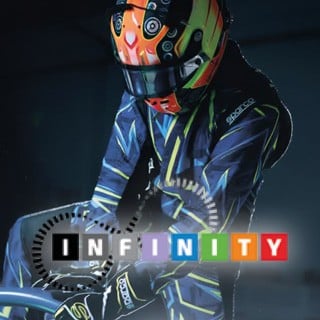
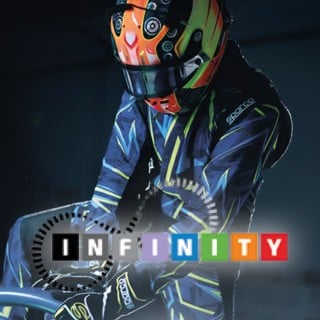
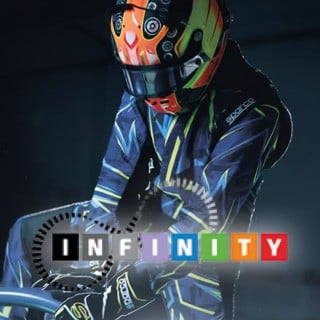
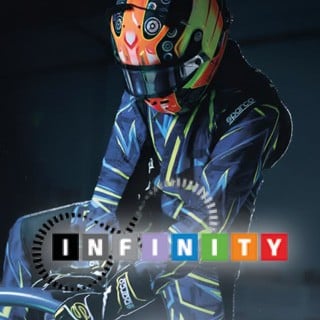
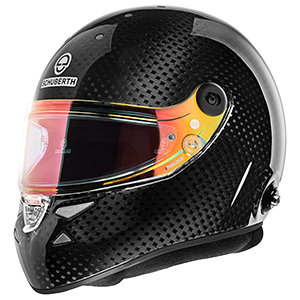 The most important item of the racing outfit from a safety perspective is a well-fitting and safe helmet.
In motorsport, you can generally drive with a full-face helmet or an open-face helmet. Logically, wearing an open-face helmet in open cars (such as convertibles and formula cars) is prohibited due to parts that can easily come into contact with the face with all the consequences that entail. The full-face helmet is absolutely the safest of the two and is therefore worn the most. Because this helmet is equipped with a chin piece and usually a visor, the driver is much better protected in the event of a serious crash and/or fire. The reason to choose an open-face helmet is that the driver often has a bit more visibility, and it gives a less claustrophobic feeling than a full-face helmet.
Motorsport helmets are made of fiberglass or carbon. The reason to choose carbon helmets is that they are generally stronger and lighter compared to fiberglass helmets. The weight advantage of a carbon helmet also results in less strain on the neck during a crash.
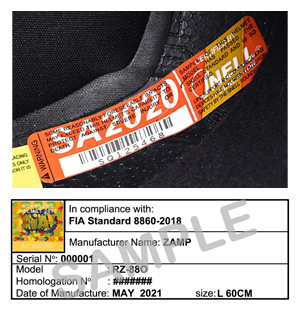 Helmets that can be used in motorsport must meet a certain certification. The Snell Foundation is the official certification institute for motorsport helmets. In addition to the Snell certification, a helmet can also be provided with an FIA certification. The FIA certification distinguishes between two standards, namely FIA 8859 and FIA 8860. The test for achieving the FIA 8860 standard is more stringent compared to the FIA 8859, hence helmets that meet the FIA 8860 standard are always made of carbon.
Always check the regulations of the event or championship you want to participate in to see if only a Snell certification is sufficient, or if the helmet must be certified for both Snell and FIA 8859 / FIA 8860.
To determine which size helmet you need, there is often only one solution; trying it on. Since every head is different, it is difficult to determine which helmet fits you perfectly. Of course, the head circumference (measured above the ears and eyes) gives a good indication, but this is often not enough to blindly buy a helmet.
Clips for an FHR system
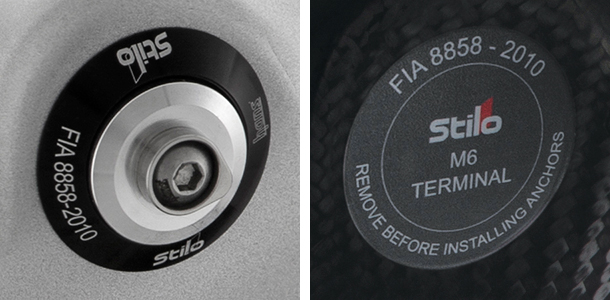 Nowadays, most helmets are factory-equipped with clips for using an FHR system (HANS or Hybrid). If this is not the case, the helmet is probably equipped with M6 threads where the clips can be mounted afterward.
Mounting the clips afterward is easy to do yourself.
Helmet design
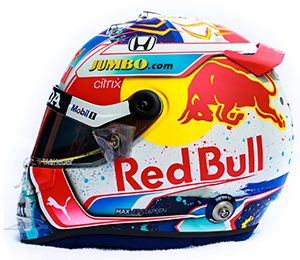 Unlike motorcycle helmets that come in the most flashy designs, motorsport helmets are almost always solid in color or, in the case of a carbon helmet, only clear lacquer is used. The reason for this is that many drivers have their helmets airbrushed in their own design. This makes the helmet more personal and makes it easy for the outside world to recognize which driver is in the car.
This airbrushing should be done with suitable materials and by experienced companies that are aware of the regulations in motorsport. Therefore, never take your valuable helmet to just any company, as this can compromise the protective function your helmet offers and even lead to the invalidation of your helmet's homologation.
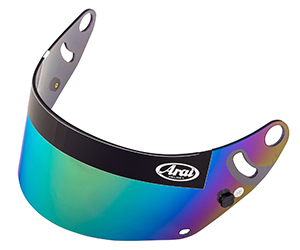 Always good visibility
For almost all motorsport helmets, tinted, coated, and/or rain visors are available. Besides a cool "look," these visors are also very comfortable, comparable to good sunglasses; indispensable in sunny or clear weather!
View our offer: Motorsport Helmets
Note! This manual takes into account the basic regulations as determined by the FIA.
Always check the regulations of the organization/event you want to participate in for any deviations.